"Who has access to this system?"
Answerable — until you are asked to prove that the list is current and that someone reviewed it.
Recertification campaigns, immutable decisions and exportable evidence — the answers an auditor asks for, produced by the product instead of rebuilt in a spreadsheet every year.
Answerable — until you are asked to prove that the list is current and that someone reviewed it.
This is where most credential stores stop. An access list is not an approval record.
Without tracking, the answer is whatever the last person to touch it remembers.
Launch a review, route each access to the person accountable for it, and record approve-or-revoke decisions that cannot be edited afterwards. The campaign itself is the evidence.
Access matrices and rotation evidence as timestamped CSV, ready to hand to an auditor rather than reconstructed the week before the audit.
Four classification levels and a named owner per item, so the protection an item gets matches what it actually protects.
A report of what a departing account could reach — the scope of the rotation you owe, stated precisely instead of estimated.
Per-folder rotation expectations with an overdue report, so drift is visible before an auditor finds it.
Weak, reused, breached and overdue credentials scored continuously, with a personal score that makes hygiene an individual metric.
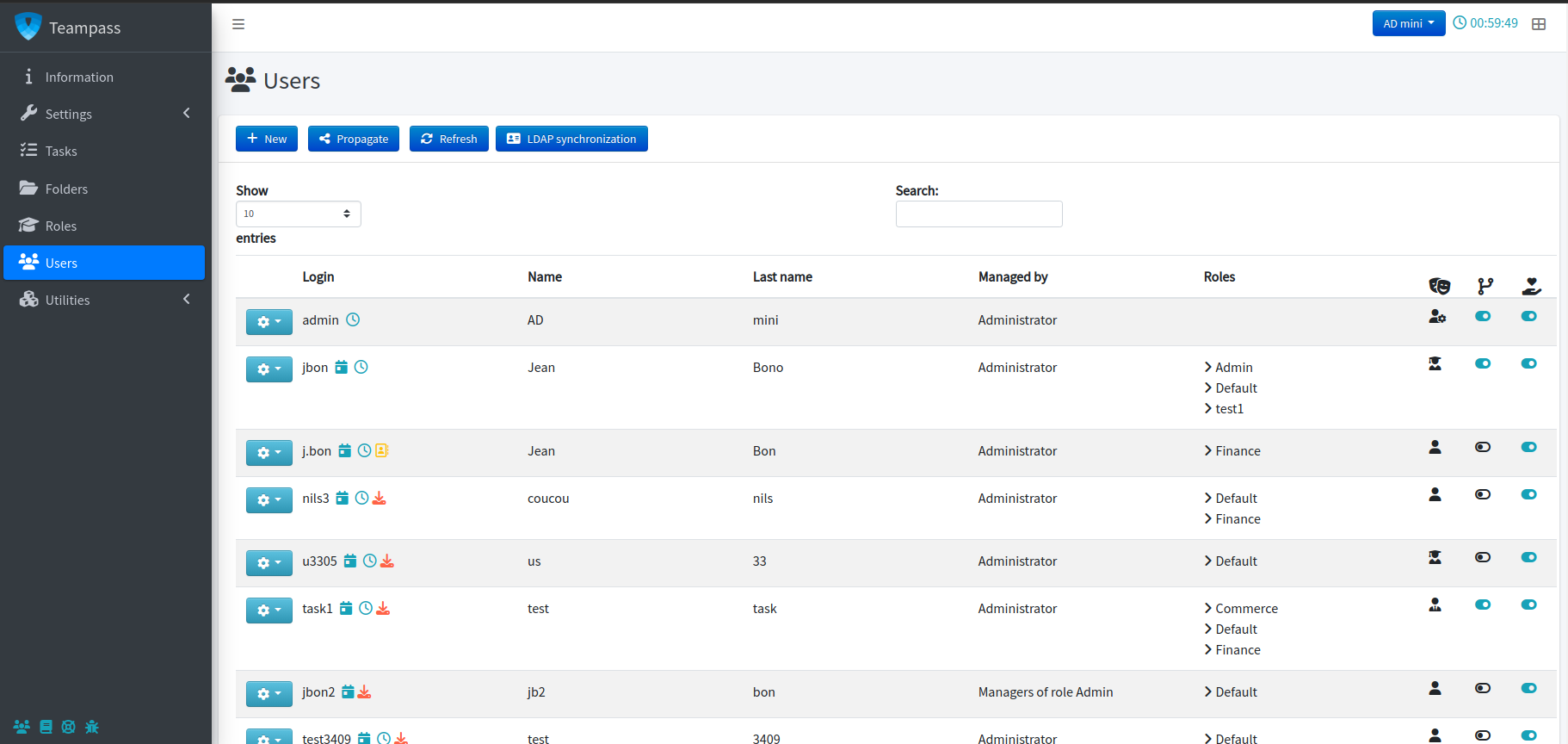
LDAP and Active Directory with nested group resolution in both login modes, or OAuth2 against your identity provider. Group-to-role mapping means joiners and leavers are handled where you already handle them.
A REST API with item and folder CRUD and the full folder tree in one call, plus native Bash and PowerShell clients. Folder rights are enforced the same way through the API as through the browser — an important detail, and one that was explicitly aligned in 3.2.1.2.
PUT and DELETE endpoints
Tracking that a credential is overdue is only half the control. LAPR performs the rotation: it generates the password from a policy, pushes it to the server over SSH, and only then re-encrypts the item — so the vault never records a password the machine refused. Agentless, with nothing installed on the targets, and with its own operator permission separate from administration.
An auditor asking "when was this last rotated, and by what process?" gets a timestamped answer naming the policy, the endpoint and the outcome — rather than a person recalling a maintenance window.
Teampass runs entirely on infrastructure you choose — your data centre, your cloud tenant, your jurisdiction. There is no vendor cloud in the path, no shared multi-tenant store, and no processor agreement to negotiate because there is no processor. For organisations answering to a regulator about where credentials physically reside, that is the whole argument.
The source is public under GPL-3.0. Your security team can read exactly how secrets are encrypted, how keys are distributed and what the API enforces — rather than taking a datasheet's word for it.
Yes. Teampass is a PHP application against a MySQL database, with no outbound dependency required at runtime. Breach-check style features that need external data are optional and can stay off.
OAuth2 single sign-on, or LDAP and Active Directory with nested group resolution in both login modes. Directory groups map to Teampass roles, so joiners and leavers follow the directory.
Yes — a REST API covering item and folder CRUD, the whole folder tree in a single call, and native Bash and PowerShell clients. Folder rights are enforced identically through the API and the web interface.
For local Linux accounts, yes — LAPR changes the password on the server over SSH and then re-encrypts the item, agentless, on a policy or on demand. Windows, directory, database and cloud identities are out of scope; see the LAPR page for exactly where the boundary sits.
Administrators manage the instance, but personal folders are decryptable only by their owner and the recovery account. Role assignment is scoped to the caller’s own roles, so an administrator cannot grant themselves rights they do not hold.
Yes — priority handling on defects and messages, sponsored feature development and deployment assistance. See the support page.
No, and you should be sceptical of any self-hosted open-source project claiming otherwise — those certifications apply to an organisation’s operations, not to a piece of software you run yourself. What Teampass does is produce the access-control evidence your own audit needs.
Install it, point it at a test directory, and run a recertification campaign. Nothing to sign, nobody to call.